According to Mitchell, the respiratory chain is folded into three oxidation reduction loops (o/r loops) as shown in Figure 8.24.
Each pair of electrons transferred from NADH to oxygen causes six protons to be translocated from inside to outside of the membrane. NADH first donates one H+ and two electrons, which together with another H+ from the internal medium reduces FMN to FMNH2. FMN extends to full width of the coupling membrane so that it can release two to the exterior of the membrane and then return electrons to the inside via Fe-S proteins, which become reduced. Each reduced Fe-S complex donates one electron to ubiquinone (Q), which after accepting a proton (H+) from inside, the membrane is reduced to QH2 · QH2, being small lipid soluble molecule, moves to the exterior of the membrane to discharge a pair of protons into the cytosol and donates two electron to moles of cytochrome b.
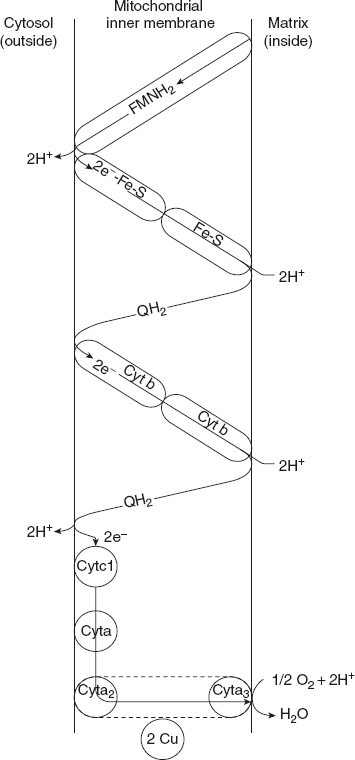
Figure 8.24 Oxidation–Reduction Loop (Proton Transport Mechanism)
Cytochrome b is thought to extend the mitochondrial membrane, enabling the electrons to join another molecule of ubiquinone along with two more protons from the internal medium. The QH2, so produced moves to the outer surface to liberate two protons and two electrons are passed onto the two moles of cytochrome c. These electrons, passing through cytochrome a, then traverse the membrane to reach cytochrome a3, which is located on the inner face of the membrane. Here two electrons combine with two protons from the internal medium and one O2 atom to form a molecule of water.
Leave a Reply