The actual measurement of the rotation of polarised light involves the use of an instrument called polariscope or polarimeter (Figure 2.8).
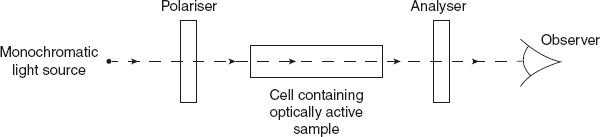
Figure 2.8 Apparatus for Measurement of Optical Activity
Because different wavelengths of polarised light are rotated differently, it is necessary to use monochromatic light. Ordinarily, the light from incandescent sodium or mercury is used. Polariscopes often have special filters designed to purify the beam of light as it passes through.
The sodium-D spectral line is composed of two wavelengths D1 (5896 Å) and D2 (5890 Å). The most satisfactory light for polariscope work is the yellow green mercury line (5461 Å), since only one wavelength is involved.
The polarising Nicol prism converts a beam of monochromatic light into plane polarised light. The light passes through a tube, then through the analysing Nichol prism, and finally through the lens. The analysing Nichol prism is mounted in the centre of a large disc with a vernier scale on the edge so that the prism may be rotated about its optical axis and the angle of rotation in degrees and functions may be read from the scale.
Biot formulated practically all the principles of optical rotation. An optically active substance has a definite rotation for a given wavelength. Rotation is proportional to the concentration of the optically active substance and to the thickness of the solution through which the light passes. It also varies with temperature. Some substances show an increase and others decrease with rising temperature. In addition, rotation varies with the nature of the solvent in which the substance is dissolved. Specific rotation can be calculated using the following formula:
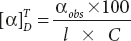
[α] = Specific rotation at temperature T with wavelength sodium lamp D1 = 5896 and D2 = 58900 Mercury lamp
αobs = Observed rotation
I = Length of the polariscope tube in decimetre
C = Concentration of substance in grams/100 ml
Leave a Reply