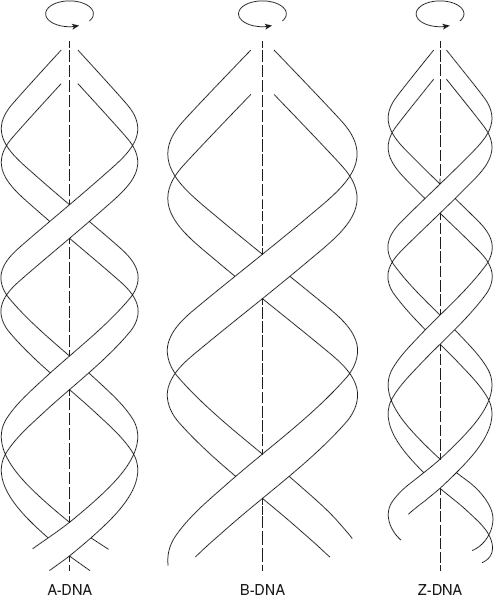
Z-DNA is longer and thinner than B-DNA. It is a left-handed helix. A single turn of Z-DNA has twelve base pairs, and the pitch of the helix is 4.56 nm. The diameter of the double helix is 1.84 nm. The major groove of Z-DNA is not a groove but it simply forms a convex surface. The minor groove of Z-DNA is like a deep cleft and it spirals around the structure. Almost all the cells contain B-DNA, though regions with guanine and cytosine base pairs assume the Z conformation.
Z-DNA is the more radical departure from B-DNA and is characterised by a left-handed helical rotation. Rick, Nordheim, and Wang discovered it in 1984. They found that a hexanucleotide, CGCGCG, forms a duplex of anti-parallel strands held together by Watson-Crick base pairing as excepted. Surprisingly, they found that this double helix was left-handed and the phosphates in the backbone were in a zigzag manner; hence they termed this new form as Z-DNA. Another remarkable characteristic of Z-DNA is that in the adjacency, regular sugar residues have alternating orientation, and it is because of this reason that in Z-DNA, the repeating unit is a dinucleotide as against the B-DNA, where the adjacent sugar residues have some orientation so that the repeating unit in B-DNA is a mononucleotide. Unlike A- and B-DNAs, Z-DNA contains only one deep helical turn, with an axial groove. There are twelve base pairs (or six repeating dinucleotide units) per helical turn, with an axial of 3.8 Å per base pair; the bases are inclined at 9° with the axis of the helix. Because twelve base pairs are accommodated in one helix Z-DNA, as against 10.4 in B-DNA, the angle of twist per repeating unit (dinucleotide) is (360 / 12 × 2) or 60° as against 34.61° per nucleotide in B-DNA. One complete helix is 45.60 Å in length in contrast to 35.36 Å in B-DNA. Since the base gets more length to spread out in Z-DNA and since the angle of tilt is 60°, they are more closer to the axis; hence, the diametre of Z-DNA molecule is 18.4 Å, whereas it is 23.7 Å in B-DNA.
Leave a Reply