Robert W. Holley and coworkers determined the base sequence of a tRNA molecule specific for the amino acid alanine in 1965. The molecular structure of rRNA is shown in Figure 5.7.
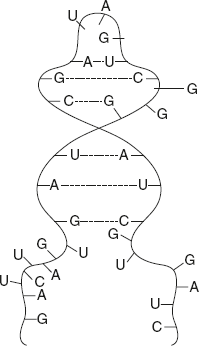
Figure 5.7 Molecular Structure of rRNA
Ribosomes and their RNAs are given in Table 5.6.
Table 5.6 Ribosomes and their RNAs
| Ribosomes | rRNA |
|---|---|
| Prokaryotic ribosomes | |
| 30S 60S | 16S 5S, 23S |
| Eukaryotic ribosomes | |
| 40S 60S | 18S 5S, 28S |
Holley first suggested the Cloverleaf model (i.e. consisting of three folds), which is based on a secondary structure, which would contain a maximum of intermolecular hydrogen bonding.
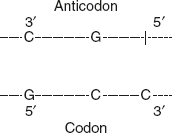
The alanyl tRNA of yeast consists of an unbranched chain of seventy-seven ribonucelotides, including 8a, 11u, 25g, 23C, and 10 unusual nucleotides, which are inosine ribothymidine, dihydrouridine, pseuodouridine, and methylated, derivatives of inosine and guanosine. The 5′ terminus is phosphorylated, whereas the 3′ terminus has free hydroxyl group. The attachment site for the amino acid alanine is 3′-hydroxyl group of the adenosine residue at 3′ terminus molecule. In the sequence inosine-– guanine-cytosine, the middle of the molecule is anticodon. It is complementary to guanine-cytosine-cytosine, one of the codon for alanine.
Leave a Reply