Great exponents of the Atreya school of physicians were the six disciples of Sage Atreya – Agnivesha, Bhela, Jatukarna, Parasara, Harita and Ksharpani. Each of them wrote a comprehensive work on the practice of medicine. These works were passed on orally in the teacher-student lineage before being put down in text form. The knowledge was passed down through generations in the form of terse poetic verses which were easy to commit to memory and this was done in-toto till the dawn of written tradition. According to tradition, Ayurveda was first described in text form in Agnivesha Tantra. It was later redacted by Charaka. This incomplete task was later extended by 17 chapters in 8th C AD by Dridabhala which became the ‘Charaka Samhita’. Modern Christian view places Charaka Samhita at 1000 BC. However ancient oral tradition places Sage Atreya around 5000 BC and Rig Veda, the first Veda, at about 1500 BC.
Table 2.1 Literature on Ayurveda
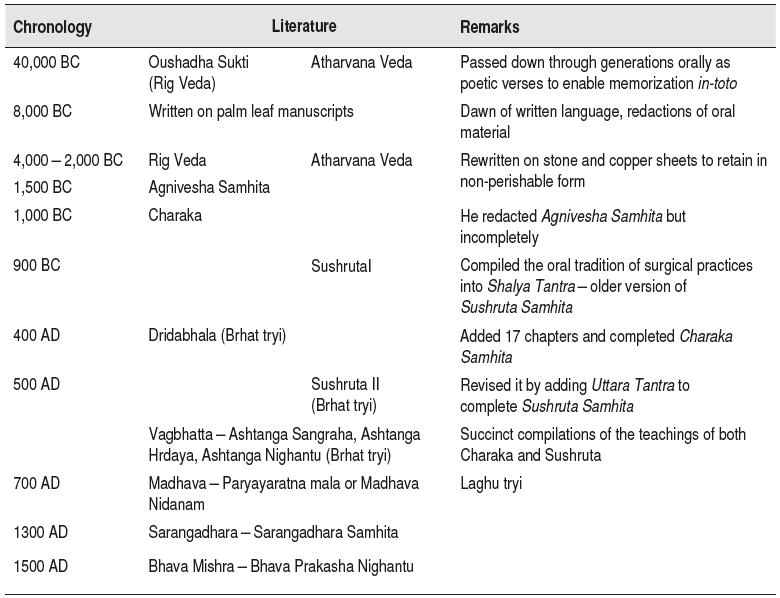
Further each of the exponents of the school of surgeons namely Sushruta, Bhoja, Gopura, Karavirya, Aupadhaneva, Aurabhra, Vaitaran, Rakshita, etc., wrote a comprehensive work on the practice of surgery and midwifery. Sushruta Samhita – another early text of Ayurveda was written around the same period (6th C AD) by Sushruta the primary pupil of Dhanwantri. In his compilation, Sushruta, known as the father of ancient surgical practices, consolidated and complemented the teachings and surgical techniques of Dhanwantri with additional findings and observations related to topics ranging from obstetrics and orthopaedics to ophthalmology.
Later during the spread of Buddhism, there was an accelerated development in the practice of Ayurveda (600–700 BCE). During this time several famous centres of medical learning – such as the Takshashila University in what is now Afghanistan – evolved that taught an apparently advanced knowledge of surgery and other specialities. This period, the golden period of Ayurveda, saw the development of newer and more effective therapies and medicines. Post Kalinga war, Emperor Ashoka, influenced by Buddhist teachings, banned bloodshed in his kingdom due to which many Ayurvedic practitioners left surgical intervention and evolved newer medical treatments. The practice of the accompanying surgery however slowly died out during this period. During the regime of Chandra Gupta Maurya (375–415 AD), Ayurveda was part of mainstream Indian medical techniques and continued to be so until the Mughal invasion and colonization by the British during which time it witnessed a drastic decline.
Leave a Reply