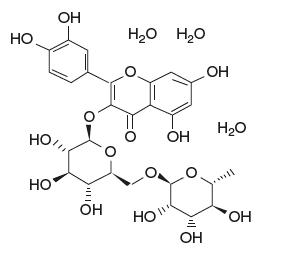
Rutin is a rhamnoglycoside of flavonol quercetin. Chemically it is quercetin-3-rutinoside or 3-[[6-O-(6-deoxy-alpha-L-mannopyranosyl)-beta-D-glucopyranosyl]oxy]-2-(3,4-dihydroxyphenyl)-5,7-dihydroxy-4H-1-benzopyran-4-one.
It occurs as a yellow crystalline powder of melting point 191°C and has a molecular formula of C27H30O16. It is highly soluble in a number of organic solvents like methanol, ethanol, pyridine etc. It is poorly soluble in cold water (12.5 g/100ml) but is fairly soluble in boiling water.
Isolation
Buckwheat is the best commercial source for production of rutin in India. The percentage rutin content is maximum at the flowering time of the plant, which is 6% to 6.6% in F. tartaricum and 2% to 4% in F. esculentum. Rutin content falls during slow drying due to leaf deterioration, while the dried leaves may be stored indefinitely. Procedures for the extraction of rutin differ according to the nature of the plant, scale of operation and they change from time to time as more knowledge of the physical and chemical properties of rutin become available.
It is poorly soluble in cold water, fairly soluble in boiling water and highly soluble in a number of organic solvents like methanol, ethanol, acetone and pyridine. In general hot water, 70% alcohol and 85% isopropyl alcohol are the commonly employed solvents for the extraction of rutin.
Leave a Reply