It is a labdane diterpene lactone and the main bitter constituent and active principal isolated from the dried stems and leaves of Andrographis paniculata (Acanthaceae). An herbaceous plant native to India and Sri Lanka, the herb commonly called Kalmegh or Chuanxin Han is used in Asian traditional medicine as anti-pyretic, anti-inflammatory and hepatoprotectant. The herb contains 0.5% to 0.9% andrographolide along with other diterpene lactones such as neoandrographolide deoxy dihydroandrographolide and andrographiside and flavonols, oroxylen, wogonin and andrographidines A, B, C, D, E and F.
Andrographolide and related diterpenes are hepatoprotective agents and also possess choleretic, antidiarrhoeal, immunostimulant and anti-inflammatory activities.
Uses
First isolated by M.K. Gorter in 1911, it is commonly used as bitter tonic, febrifuge and hepatoprotective. It is reported to inhibit hepatic microsomal lipid peroxidation. Among the complex mixture of biologically active compounds present in the plant, andrographolide can be used as an analytical marker to determine the quality of plant material from different sources.
Kalmegh forms an ingredient of many patented Indian herbal proprietary preparations for the treatment of liver ailments.
Description
Andrographolide occurs as colourless crystalline powder with an extremely bitter taste. Its molecular formula is C20H30O5, IUPAC name is 3α, 14, 15, 18–tetrahydroxy-5β, 9βH, 10α – labda– 8(20), 12–dien- 16-oic acid γ- lactone. The molecule has two forms of lactone rings. While two are present in the methylene dioxy group, the fifth is present as an alcoholic group of tertiary character. It is sparingly soluble in water, but freely dissolves in acetone, methanol, chloroform and ether. It has a melting point of 230–231°C.
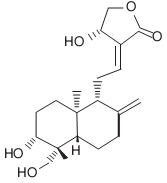
Andrographolide forms white rhombic prisms or plates from ethanol or methanol with a melting point of 218°C.
Leave a Reply