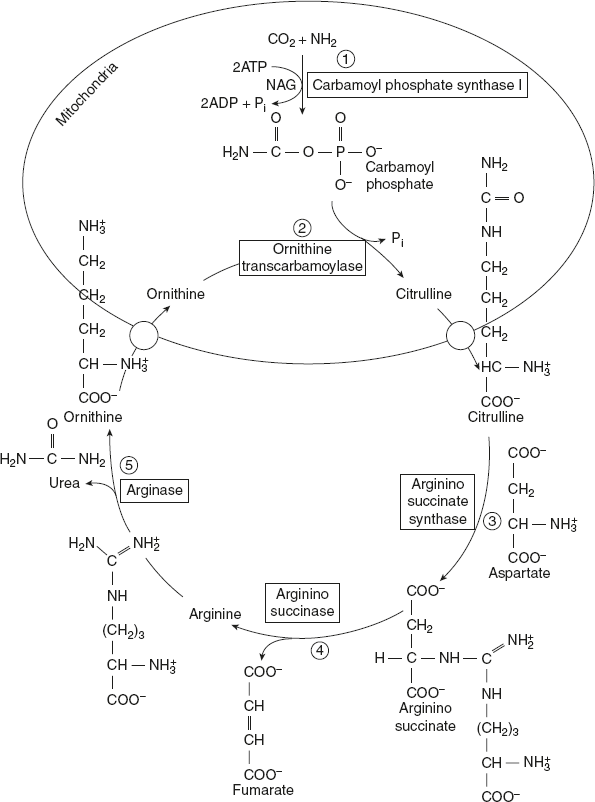
The skeleton of urea consists of two amino (—NH2) groups and one carbon atom. The first (NH2) group is derived from glutamate reservoir (—NH2) and the second (—NH2) group is derived from aspartate. The carbon atom is derived from CO2. The urea cycle occurs in five steps with five enzymes. The first two enzymes are located in mitochondria while the rest are located in cytosol.
- Synthesis of carbamoyl phosphate:Carbamoyl phosphate synthase I (CPS I) in the mitochondria condenses the ammonium ions
 with CO2 to form carbamoyl phosphate. During this step, two moles of ATP are consumed and this is an irreversible and rate-limiting step. N-acetyl glutamate (NAG) is involved in this process. Carbamoyl phosphate synthase II is involved in pyrimidine synthesis and is present in cytosol. CPS II accepts amino group from glutamine and does not require N-acetylglutamate for its activity.
 - Formation of citrulline:The second step in urea cycle is the formation of citrulline. It is produced from carbamoyl phosphate and ornithine. Ornithine is reused in the urea cycle. So its role is comparable to oxaloacetate in the citric acid cycle. Citrulline is then transferred to cytosol by the transporter system.
- Synthesis of argininosuccinate:Citrulline condenses with aspartate and produces argininosuccinate. The second amino group is incorporated in this reaction and this step requires ATP.
- Cleavage of argininosuccinate:Argininosuccinase cleaves argininosuccinate to fumarate and arginine. Fumarate acts as the connecting link with TCA cycle and gluconeogenesis. Arginine is the next precursor for urea production.
- Formation of urea:Arginase cleaves arginine and produces the final products urea and ornithine. Ornithine so produced enters mitochondria for its reuse in the urea cycle. Arginine is induced by CO2 and Mn2+. Ornithine and lysine compete with Arginase (competitive inhibition). Arginase is present in liver, whereas the rest of the enzymes are present in other tissues. Hence, arginine synthesis may occur in various tissues but only the liver can finally produce urea. The synthesis of urea is presented in the structure given below:
Leave a Reply