Chromatography refers to a broad range of physical methods for the separation and/or analysis of complex mixtures of compounds. Plant drugs being constituted of multitudes of phytochemical groups, chromatographic techniques find immense application in their separation, processing, purification, and in qualitative and quantitative analysis. Developments in the field of chromatography have facilitated parallel rapid advancement in our understanding of complex phytochemical profiles of valuable plant drugs. It has been one of the most useful techniques of general application not only to the field of phytochemical analysis, but also to a host of other biochemical processing sectors requiring rapid and efficient resolution of complex mixtures of chemicals.
Basically chromatography involves separation of components of a mixture due to their preferential distribution between a stationary phase and another “mobile” phase that moves through it. Separation is effected due to differential rates of migration of the components of the mixture because of their different adsorption/desorption affinity for the stationary phase as it is carried across by the mobile phase. As a result, different rates of affinity of the components to the phases effect their separation as they are flushed through by the mobile phase over the stationary phase. In other words, subtle differences in a compound’s partition coefficient result in differential retention on the stationary phase effecting their separation.
Having originated in the mid 19th century as a form of separation of coloured dyes and plant pigments, chromatography literally means “colour writing.” It has since then developed into many newer forms of much utility for a wide range of separation processes in chemical analysis. Today chromatography and the various automated instrumental analytical methods developed based on its principle comprise a unique and specialized branch of “Separation Science.” All of these techniques facilitate resolution of mixtures into components due to adsorption/partitioning/ion exchange.
The innumerable techniques based on chromatography ultimately serve either preparative or analytical purposes. Chromatography is preparative when there is quantitative separation of components of a mixture and it is analytical when it aids qualitative identification of the mixture components post separation or estimation of their relative proportions.
The chromatographic identification, isolation, purification, and quantification of phytoconstituents is essentially carried out by a combination of four types of methods. They are:
- Paper Chromatography (PC)
- Thin Layer Chromatography (TLC)
- Column Chromatography (CC) and
- Gas Chromatography (GC)
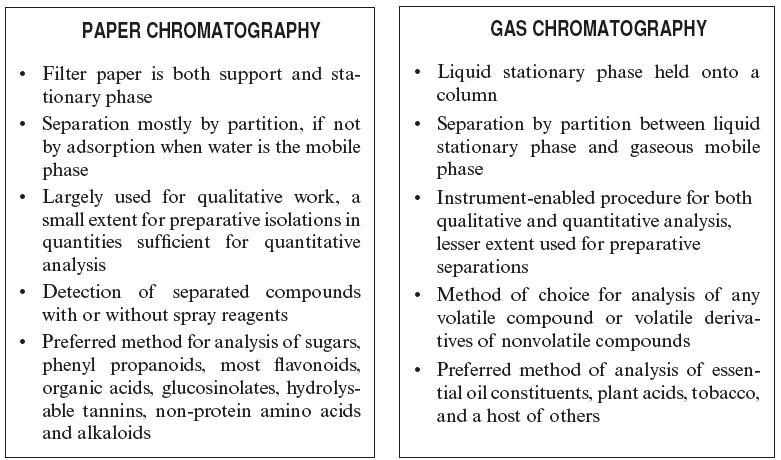
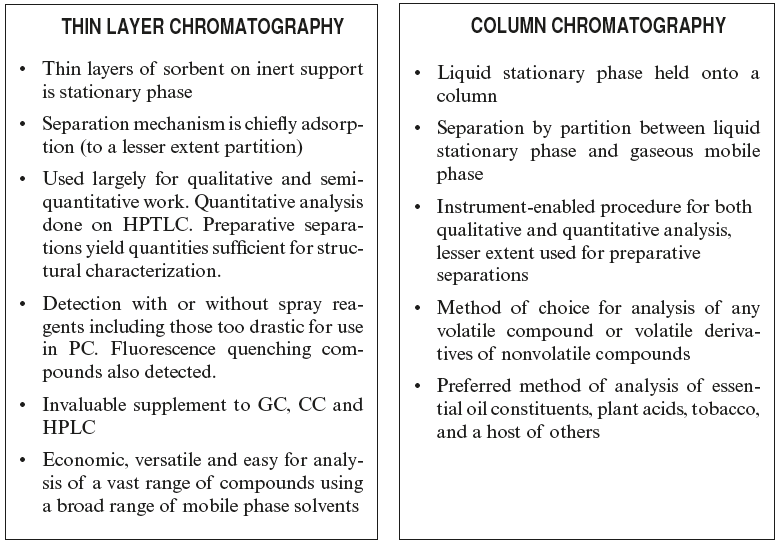
Figure 7.1. Chromatographic techniques widely used in phytochemical analysis
Leave a Reply