- Almost all tRNA molecules have a cloverleaf shape, consisting of three folds.
- All tRNA molecules are unbranched chains, containing from seventy-three to ninety-three ribonucleotides; tyrosyl-tRNA contains seventy-eight nucleotides, and seryl-tRNA contains eighty-five nucelotides. Their molecular weight approximates 25,000.
- They contain from seven to fifteen unusual bases. Many of these unusual bases are methylated or dimethylated derivatives of A, U, G, and C. These include nucleotides of pseudouridine, various methylated adenines and guanines, methylated pyrimidines such as thymine and 5-methylcytosine and others.Not all these are present in any one source of tRNA, but pseudouridne is the most abundant and universally distributed.Although the role of these bases is uncertain, two roles seem certain:
- Methylation prevents the formation of certain base pairs so that some of the bases become accessible for other interactions.
- Methylation imparts hydrophobic character to some portions of tRNA molecules, which may be important for their interaction with synthetases and ribosomal proteins.
- The 5′ end of tRNA is phosphorylated. The 5′ terminal residue is usually Pg.
- The base sequence at the 3′ end of all tRNA is CCA. All amino acids bind to this terminal adenosine via the 3′-OH group of its ribose.(5′ end) G –––––––––––––– tRNA –––––––––––––– CCA (3′ end)
- About 50% of the nucleotides in tRNAs are base paired to form double helices.
- There are, however, five groups of bases, which are not base paired. These five groups, of which four form loops, are the following:
- The 3′ CCA terminal region
- The ribothymine-pseudouracil-cytosine (=TψC) loop
- The extra arm or little loop, which contains a variable number of residues
- The dihydrouracil (=DHU) loop, which contains several dihydrouracil residues
- The anticodon loop, which consists of seven bases with the sequence5′ –––––––––––– py-py-X-Y-X-modified purine – variable base ––– 3′This loop contains a triplet of bases, which allows the tRNA to hydrogen bond to a complementary sequence on mRNA attached to a ribosome.
- The four loops are recognition sites. Each tRNA must have at least two such recognition sites: one for the activated amino acid – enzyme complex, with which it must react to form the aminoacyl-tRNA and another for the site of messenger RNA molecule, which contains the code (codon) for that particular amino acid. It is interesting to note that the former involves recognition by bases of amino acid residues (either of the activated amino acid or of a site on the enzyme molecule), whereas the latter involves recognition by bases of bases (hydrogen bonding).
- An unique similarity among all tRNA molecules is that the overall distance from CCA at one end to the anticodon at the other end is constant. The difference in nucleotide numbers in various tRNA molecules is, in fact compensated for by the size of the extra arm, which is located between the anticodon loop and T ψ C loop.
The tertiary structure (or three-dimensional structure) of a tRNA molecule is given in Figure 5.8.
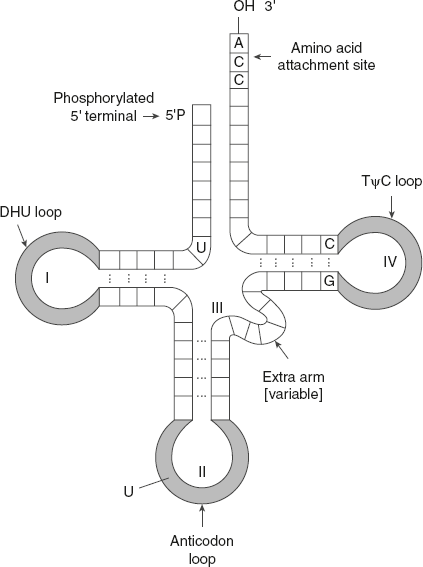
Figure 5.8 Structure of tRNA
Alexander Rich and Aaron Klug on the basis of their X-ray crystallographic studies have elucidated the 3-D structure of the phenylalanine-accepting tRNA from yeast as shown in Figure 5.9. The important features observed by them are the following:
The molecule is L-shaped.
The two segments of the double helix contain about 10 base pairs per turn of helix. The helix is perpendicular to each other and forms an L shape.
Amino acids are attached to the CCA terminus, which is at one end of the L. The other end of L contains an anticodon loop. DHU and TψC loops occupy the corners of the L.
The CCA terminus and the helical region of the adjacent group do not react with the remaining amino acids and thus induce a change in conformation during amino acid activation and protein synthesis.
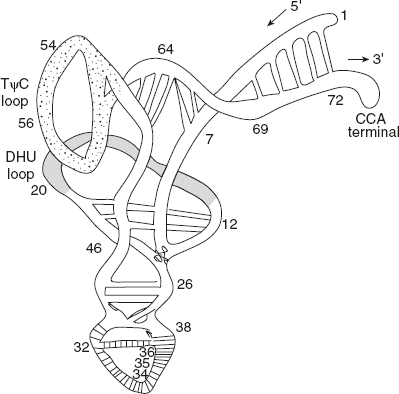
Figure 5.9 Tertiary structure (Three dimensional structure)
Leave a Reply