Chemically it is 1, 3, 7-trimethyl xanthine and has the molecular formula C8H10N4O2. Caffeine has a bitter taste, is odourless and occurs as a white powder or as white needles. In its anhydrous form, caffeine contains one molecule of water of hydration; caffeine in solution is neutral in pH. It has melting range of 235–238°C over which it decomposes by sublimation. Its solubility in water is 22mg/ml at 25°C, 180 mg/mL at 80°C and 670 mg/mL at 100°C. It is soluble in solvents such as acetone, ethyl ether, ethanol, chloroform, methylene chloride etc.
Caffeine is obtained from tea dust, as a by-product from the manufacture of decaffeinated coffee or synthetically prepared via several methods, including from dimethylurea and malonic acid.
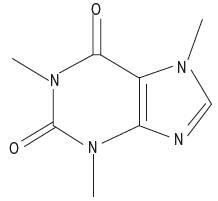
Isolation
Several methods and different solvents such as dichloromethane, chloroform, ethyl acetate and supercritical carbon dioxide are used in the extraction of caffeine from tea and other sources. Dichloromethane is used for the decaffeination of several conventional teas.
A. Method I
Tea leaves mostly contain cellulose, tannins and chlorophyll apart from caffeine. Dichloromethane is the most widely used solvent for extracting caffeine from tea leaves as caffeine is more soluble in dichloromethane (140 mg/ml) than in water (22 mg/ml). Also its extracting efficiency is 98% to 99%. Caffeine being more soluble in hot water, it is initially extracted into boiling water, which on cooling is shaken with dichloromethane. Tannins partially soluble in dichloromethane are converted to salts by the added sodium carbonate, in which form they move into the aqueous phase. However tannin salts being anionic surfactants tend to emulsify with water. Hence the solution is not to be vigorously shaken.
- Place 30 g of the tea leaves in a 500 ml beaker. Add 250 ml of distilled water and 5 g of sodium carbonate and stir the contents of the beaker with a glass rod. Boil the contents of the beaker on a hot plate/water bath for 10 minutes.
- Place a watch glass on top of the beaker to prevent excessive evaporation. Filter the hot solution through a glass funnel plugged with a small piece of cotton into a 250 ml conical flask.
- Transfer the tea leaves back into the beaker. Add 100 ml of distilled water and again bring the contents to a boil.
- Filter and combine the filtrate with the earlier lot in the 250 ml conical flask. Discard the tea leaves.
- When the filtrate is cooled to room temperature, transfer into a 250 ml separatory funnel. Extract with 25 ml of dichloromethane without vigorous shaking.
- Carefully drain the lower (dichloromethane) layer into a clean 100 ml conical flask.
- Extract further with 2 × 20 ml portions of dichloromethane, combine the organic layers and run through a bed of anhydrous sodium carbonate packed atop a glass funnel plugged with cotton wool.
- The moisture-free filtrate is then gently heated on a hot plate to evaporate dichloromethane.
- The dried residue of caffeine is purified by recrystallization from hot ethanol. Pure caffeine is vacuum dried and weight noted.
B. Method II
- Briefly, 20 g of tea and 90 ml of distilled water is refluxed for 30 min, and filtered under vacuum. The residue is again refluxed with 50 ml distilled water and filtered.
- Obtained filtrates are combined, 12.5 ml of 10% lead acetate solution is added, boiled (5 min) and filtered through a Buchner funnel with silica gel layer.
- The filtrate is extracted four times with chloroform (40 ml). Combined chloroform phases are washed with 5% KOH solution (to remove traces of acetate) and then with distilled water.
- Chloroform extracts are dried in a rotary evaporator.
- The crude caffeine is recrystallized using a mixed-solvent system that involved dissolving it with 5 ml hot acetone followed by the addition of hexane until the solution turns cloudy. The solution is cooled, crystalline caffeine collected by vacuum filtration and the weight noted.
Identification
- Murexide test: To a few crystals of caffeine taken in a porcelain dish add 3 to 4 drops of concentrated nitric acid and evaporate to dryness. Add 2 drops of ammonium hydroxide to the residue. A purple colour is obtained.
- To about 50 mg of caffeine taken in a porcelain dish add a 1 ml hydrogen peroxide and a few drops of 2% HCl. Evaporation to dryness gives a bright red colour which turns purple on addition of a few drops of ammonia solution.
- Thin layer chromatography (TLC) identification: A few crystals of caffeine are dissolved in dichloromethane and spotted on a silica gel plate and developed in the solvent system: ethyl acetate: methanol: water (100:13.5:10). For activation it is first sprayed with potassium iodide solution (1g potassium iodide and 1g iodine dissolved in 100 ml ethanol), followed by spraying with a 1:1 mixture of 25% HCl and 96% ethanol (I/HCl reagent).Caffeine is identified as a dark brown spot discernible in visible light. Standard caffeine may be co-spotted as positive control.
Leave a Reply