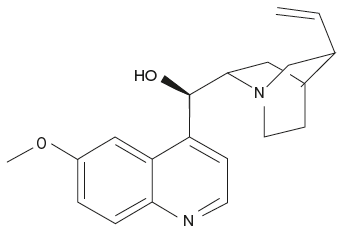
Quinine is a natural white crystalline, odourless alkaloid readily soluble in ether and chloroform. Slightly soluble in water, it is also soluble in alcohol, carbon disulphide and glycerol. Intensely bitter to taste, its molecular formula is C20H24N2O2 and has a melting point of 173–175°C. Being a diacidic base, it forms both acid and neutral salt. While neutral salts are formed by the involvement of tertiary N atom in the quinnuclidine ring, acid salts are formed by the involvement of both the nitrogen atoms.
Sulphate salts of quinine are white, odourless, bitter, fine, needle-like crystals which are soluble in water and alcohol.
Sensitive to UV light quinine fluoresces in direct sunlight due to its highly conjugated resonance structure.
Quinine and salts of quinine are laevorotatory and with sodium and potassium alkyl iodide, quinine forms a series of periodides called kerapathite. While quinine sulphate is given orally, quinine hydrochloride may be administered intravenously.
Isolation
Different cinchona species and its hybrids contain 5% to 14% of total alkaloids of which 30% to 60% is constituted of quinine-type alkaloids. The principal alkaloids are the stereoisomers quinine and quinidine and their respective demethoxy derivatives cinchinidine and cinchonine. Other minor amorphous alkaloids have also been reported. Cinchona alkaloids are present in the bark tissue in combination with quinic acid and cinchotannic acid. The absolute and relative proportions of the alkaloids of cinchona bark varies with cultural and climatic conditions and also in relation to the position on the tree from which the bark is removed. In general, the content of total alkaloids is greater in the root bark and at the base of the tree than in the upper parts of the trunk.
- Bark dried to a moisture content of 12% to 15% is finely powdered and intimately mixed with about 30% of its weight of calcium hydroxide and the mixture made into a stiff paste with sufficient quantity of 5% solution of sodium hydroxide.
- The mix is transferred to a percolator and extracted to exhaustion with petroleum ether (80°–100°C).
- The petroleum ether extract is then shaken with successive portions of warm dilute sulphuric acid for complete extraction of alkaloids into the acid layer.
- The combined acid extracts while still warm are adjusted to pH 6.5 with dilute sodium hydroxide and the solution is allowed to cool.
- Crystals of crude quinine sulphate which separate on cooling are separated by centrifugation and purified by recrystallization from hot water using finely divided carbon for removing colouring matter.
- Quinine sulphate is dissolved in warm dilute sulphuric acid and dilute ammonia solution is added with continual stirring until the solution is alkaline to litmus
- Base quinine is liberated as an amorphous precipitate which upon standing forms a microcrystalline mass. The mixture is filtered and the residue of quinine is washed free of sodium and ammonium salts and dried at a low temperature.
Leave a Reply