C.mukul is a thorny tree, 4–6 feet tall. It is leafless most of the year and has a dry ash-coloured bark that flakes off easily. For the collection of oleoresin, the tree is tapped by making circular incisions on the main stem no deeper than the thickness of the bark. The yellowish exudate that oozes out dries and it is collected by scraping. The agglomerate mass of the dried material is collected from all the incisions made at a time. It is freed of extraneous plant parts before processing.
- The collected gum guggulu is taken in four times its weight of hot water and set aside overnight.
- The next day it is heated gently in iron pans (under dry and sunny conditions using mild heat) with continuous stirring to concentrate the quantity of water to half its volume. Industrially it is heated in steam-jacketed pans under controlled temperatures of 50–60°C. Heating removes most of the volatile material from the oleo gum resin.
- The hot solution is then filtered through a cotton cloth or mesh. Traditionally further purification is done by processing it with added herbs depending upon the medical condition for which it is being taken.
- For commercial purposes or for the preparation of standardized extracts, the hot solution is filtered through a #100 mesh and the filtrate further concentrated under vacuum. So concentrated aqueous extract is then lyophilized or spray dried to yield a fine powder.
Figure 8.1 gives the schematic diagram of the steps involved in the fractionation for concentrating guggulsterones. The purified resin is specifically fractionated by solvent extraction to yield standardized extracts or fractions rich in guggulsterones. Its ethyl acetate extract contains 4% to 4.5% guggulsterones. The neutral subfraction contains 4.2% to 4.7% guggulsterones. The ketonic subfraction of the neutral subfraction contains 35% to 40% guggulsterones, from which the 10% E- and Z-guggulsterones are derived.
Estimation
Guggulipid, the purified resin, gum guggulu and preparations containing guggulu extracts may be analysed for the concentration of guggulsterones by thin layer chromatography (TLC) and HPLC/mass spectrometry (MS) and colorimetric methods.
A. Method I (Quantitative)
- 5 g of accurately weighed sample is extracted with 25 ml chloroform by a sonicator for 20 min, filtered and evaporated to dryness in a tared beaker.
- Sample solution: Transfer 100 mg of the sample into a 10 ml standard flask and dissolve in sufficient chloroform and make up to the mark. Sonicate the solution and filter through a Whatman filter paper.
- Standard solution: Disslove 10 mg of standard sample of guggulusterone Z in 10 ml chloroform. Dilute 1 ml of this solution to 10 ml with chloroform (100 µg/ml). Prepare a series of dilutions to get solutions ranging from 10 µg/ml to 60 µg/ml.
- Spot 10 µl each of the standard and sample solutions on precoated silica gel aluminium plates.
- Develop in mobile phase of petroleum ether (60–80°C): ethyl acetate: methanol (6:2:0.5 v/v).
- Dry the plates and scan them in fluorescence mode at 254 nm. Note the peak areas of standard. These are plotted against corresponding concentrations to generate the calibration equation for the marker.
- Determine the concentration of guggulusterone Z from its known peak area using the calibration curve.
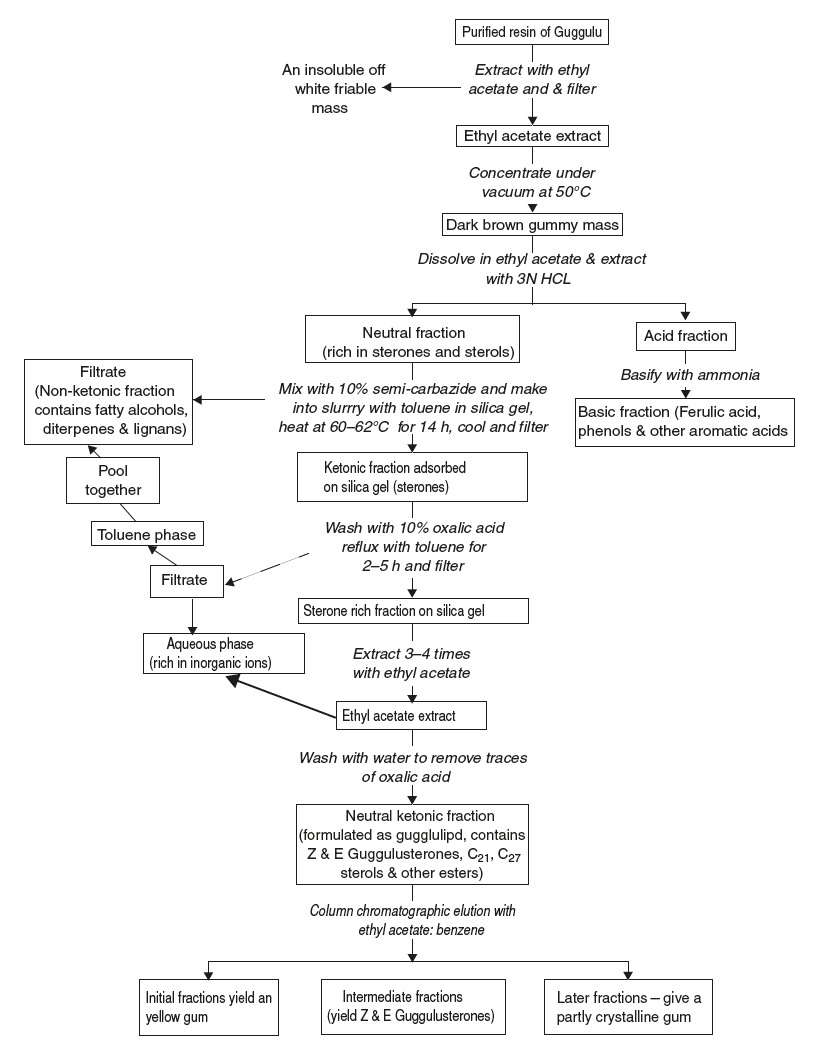
Figure 8.1 Processing of guggulu resin
Leave a Reply