Glycolysis occurs in all cells, and in some cells, it is the sole source of energy like brain cells, erythrocytes.
Organelle: It occurs in cytoplasm of the cells.
Steps
Glycolysis is also called Embden Meyerhof pathway. In glycolysis, the breakdown of the six-carbon glucose into two molecules of the three-carbon pyruvate occurs in ten steps,
Glycolysis is divided in to two phases:
- Preparatory phase
- Pay-off phase
1. Preparatory phase
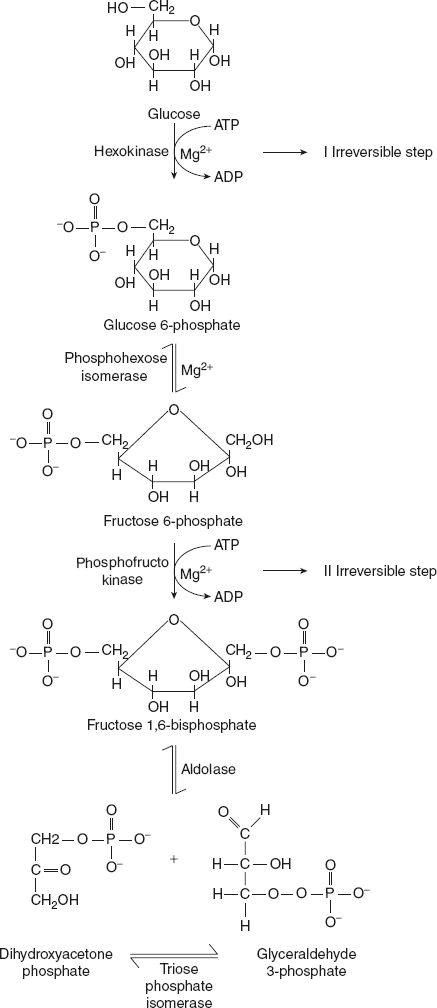
Step 1: Glucose to glucose 6-phosphate (Phosphorylation of glucose)
In the first step of glycolysis, glucose is activated for subsequent reactions by its phophorylation at C-6 to yield glucose 6-phosphate with ATP as the phosphoryl donor.
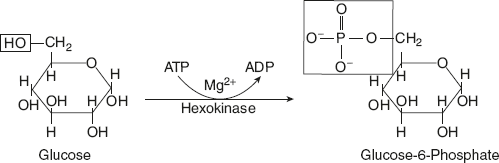
This reaction, which is irreversible under intracellular conditions, is catalysed by hexokinase.
Hexokinase, like many other kinases, requires Mg2+ for its activity because the true substrate of the enzyme is not ATP4− but the Mg ATP2− complex.
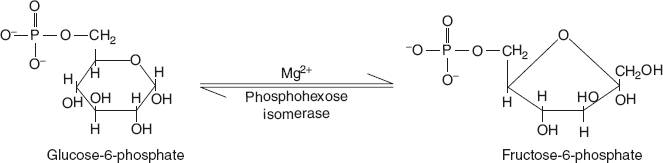
Step 2: Conversion of glucose 6-phosphate to fructose 6-phosphate
The enzyme phosphohexose isomerase (phosphoglucose isomerase) catalyses the reversible isomerisation of glucose 6-phosphate, an aldose, to fructose 6-phosphate, a ketose.
Step 3: Phosphorylation of fructose 6-phosphate to fructose 1,6-bisphosphate
In the second of the two priming reactions of glycolysis, phosphofructokinase-1 (PFK-1) catalyses the transfer of a phosphoryl group from ATP to fructose 6-phosphate to yield fructose 1,6-bisphosphate.

The PFK-1 reaction is essentially irreversible under cellular conditions. It s the major point of regulation in glycolysis.
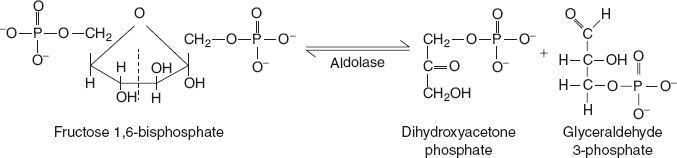
Step 4: Cleavage of fructose 1, 6-bisphosphate
The enzyme fructose 1,6-bisphosphate aldolase, often called simply aldolase, catalyses a reversible aldol condensation. Fructose 1,6-bisphosphate is cleaved to yield two different triose phosphates, glyceraldehyde 3-phosphate, an aldose, and dihydroxyacetone phosphate, a ketose.
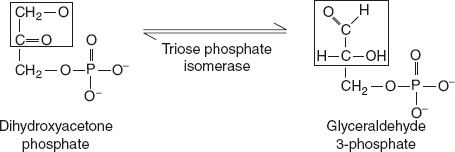
Step 5: Inter-conversion of the triose phosphates
Only one of the two triose phosphates formed by aldolase, glyceraldehydes 3-phosphate, can be directly degraded in the subsequent steps of glycolysis.
2. Pay-off phase
The pay-off phase of glycolysis includes the energy-conserving phosphorylation steps in which some of the free energy of the glucose molecule is conserved in the form of ATP. Remember that one molecule of glucose yields two molecules of glyceraldehyde 3-phosphate; both halves of the glucose molecule follow the same pathway in the second phase of glycolysis.
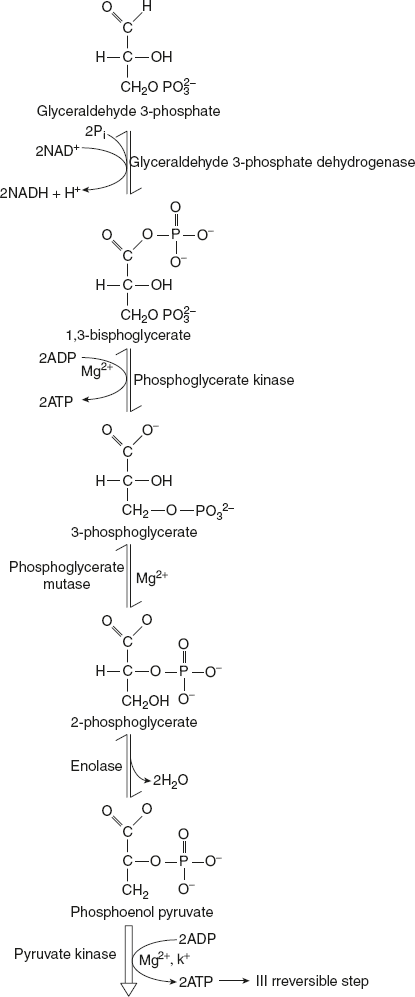
Step 6: Oxidation of glyceraldehyde 3-phosphate to 1,3-bisphosphoglycerate
The first step in the pay-off phase is the oxidation of glyceraldehyde 3-phosphate to 1,3-bisphosphoglycerate, catalysed by glyceraldehyde 3-phosphate dehydrogenase.
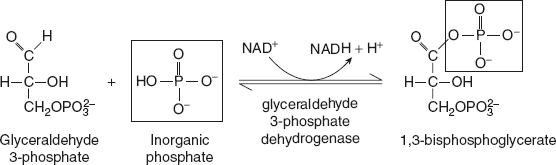
This is the first of the two energy-conserving reactions of glycolysis that eventually lead to the formation of ATP.
Step 7: Phosphoryl transfer from 1,3-bisphosphoglycerate to ADP
The enzyme phosphoglycerate kinase transfers the high-energy phosphoryl group from the carboxyl group of 1,3-bisphosphoglycerate to ADP, forming ATP and 3-phosphoglycerate.
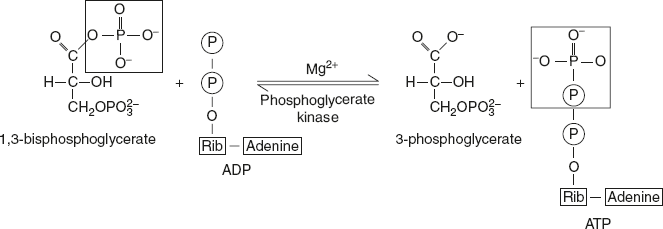
The formation of ATP by phosphoryl group transfer from a substrate such as 1,3-bisphosphoglycerate is referred to as a substrate-level phosphorylation.
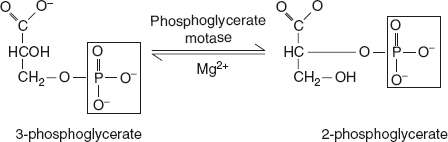
Step 8: Conversion of 3-phosphoglycerate to 2-phosphoglycerate
The enzyme phosphoglycerate mutase catalyses a reversible shift of the phosphoryl group between C-2 and C-3 of glycerate; Mg2+ is essential for this reaction.
Step 9: Dehydration of 2-phosphoglycerate to phosphoenolpyruvate
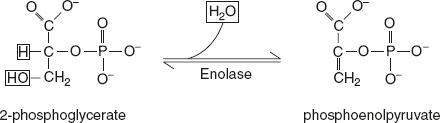
In the second glycolytic reaction that generates a compound with high phosphoryl group transfer potential, enolase promotes reversible removal of a molecule of water from 2-phosphoglycerate to yield phosphoenolpyruvate (PEP).
Step 10: Transfer of the phosphoryl group from phosphoenolpyruvate to ADP
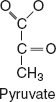
The last step in glycolysis is the transfer of the phosphoryl group from phosphoenolpyruvate to ADP, catalysed by pyruvate kinase, which requires K+ and either Mg2+ or Mn2+.
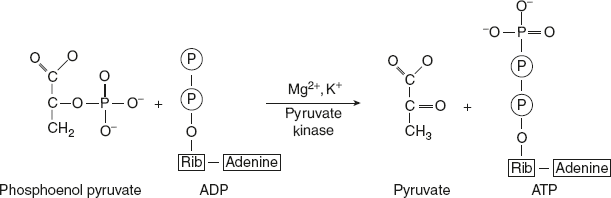
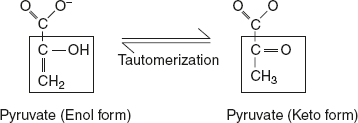
In this substrate-level phosphorylation, the product pyruvate first appears in its enol form and then tautomerises rapidly and non-enzymatically to its keto form.
Leave a Reply