Source
Menthol is a terpene alcohol obtained from diverse mint oils or prepared synthetically by hydrogenation of thymol. It occurs naturally in peppermint oil to the extent of 50% to 60% along with methyl acetate, menthyl isovalerianate and small amounts of other terpenes. Peppermint oil refers to the steam distilled essential oil isolated from the aerial parts of various species of the mint family such as Mentha piperita, Mentha arvensis and Mentha canadensis (Labiateae). M. arvensis is extensively cultivated in India, the largest producer of menthol and related products in the world.
The oil composition of peppermint oil is greatly influenced by genetic factors and seasonal variations. Peppermint oil typically produces l–menthol with smaller amounts of stereoisomers d-neomenthol, d-isomenthol and d-neoisomenthol.
Peppermint oil high in ester content is prized for its fine aroma and pleasant taste and is one of the most important and widely used essential oils due to its fine pungent taste which is followed by a cooling sensation. Japanese peppermint oil obtained from M. arvensis is high in menthol content and is therefore solely employed for the isolation of menthol. Peppermint oil is extensively employed in pharmaceuticals and oral preparations such as toothpaste, dental creams, mouth washes, cough syrups, chewing gums, confectionary, tobacco, betel nut, cigarettes and in alcoholic beverages. It has stimulant, carminative, counter-irritant and antiseptic properties. Menthol has the characteristic peppermint odour and flavour and gives a cool sensation when applied on the skin.
Uses
Menthol is used in foods, topical therapeutic preparations, oral hygiene and dentifrice formulations and tobacco products due to its pleasant minty flavour and the cooling sensation it imparts when in contact with the skin or oral membranes. Menthol is combined with camphor and eucalyptus oil in ointments, cough preparations, nasal sprays and inhalants to relieve symptoms of bronchitis, sinusitis and nasal congestion. This characteristic cooling sensation is produced by interaction with cold receptors rather than the taste buds, so manifestation of the characteristic cooling qualities is not limited to the oral cavity. Menthol produces the sensation of coolness in the oral and olfactory regions only at low concentrations, as higher concentrations induce a burning sensation coincident with some modest degree of desensitization. Menthol has local anesthetic and counter-irritant qualities.
Description
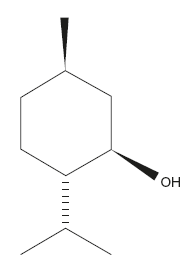
Menthol is 2-(2-Propyl)-5-methyl-1-cyclohexanol. It is a monocyclic terpene alcohol having three asymmetric carbon atoms in the cyclohexane ring, yielding a variety of isomers. While l-menthol constitutes the predominant isomer in natural botanical sources, the racemic mixture dl-menthol is produced synthetically. The dl racemate exhibits about half of the cooling properties of l-menthol and finds use mainly in topical skin care products.
Its molecular formula is Cl0H20O. Though known in Japan since ancient times it was first isolated in the west by H.D. Gaubius in 1771. Menthol occurs as white or colourless hexagonal or needle-like crystalline or granular solid, with peppermint taste and odour. It has a melting point of 41–43°C and a boiling point of 212°C. It is slightly soluble in water, very soluble in alcohol, chloroform, ether, petroleum ether and freely soluble in glacial acetic acid.
Leave a Reply