Dietary sources of fructose include fruit, honey, and the disaccharide sucrose. Fructose is a significant source of carbohydrate in the human diet. It can enter the glycolytic pathway by two routes. In liver, fructose is converted to fructose-1-phosphate by fructose kinase.
When fructose-1-phosphate enters the flycolytic pathway, it is first split into dihydroxyacetone phosphate (DHAP) and glyceraldehyde-3-phosphate by triose phosphate isomerase. Glyceraldehyde-3-phosphate is generated from glyceraldehyde and ATP by glyceraldehyde kinase as shown in Figure 8.31.
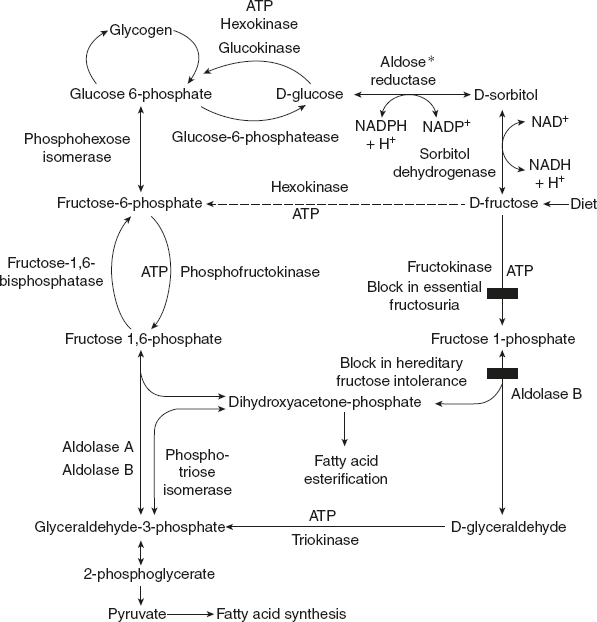
Figure 8.31 Metabolism of Fructose
The conversion of fructose-1-phosphate into glycolytic intermediates bypasses two regulatory steps by hexokinase and PFK-1. Thus, fructose is metabolised more quickly than glucose.
In muscle and adipose tissue, fructose is converted into glycolytic intermediate fructose-6-phosphate by hexokinase. As the hexokinase has a low affinity for fructose, this reaction is of minor importance unless fructose consumption is exceptionally high.
Leave a Reply