It is a small bushy shrub or tree, 4–6 ft in height with thorny branches. The leaflets are 1–3 in number and obovate and the tree, however, remains largely leafless throughout the year. The ashcoloured bark comes off in rough flakes exposing the under bark, which also peels off in papery rolls. The tree bears small brownish flowers, slightly ascending branches, and alternate trifoliate leaves. The fruit is a red, ovate, drupe when ripe.
The oleo gum resin from the plant is obtained by incision of the bark during the cold season. It is collected by tapping at regular intervals for some weeks following incision of the bark. The oleo gum resin that oozes out is a sticky yellowish fragrant fluid, which turns into brownish yellow fragments with an aromatic balsamic odor and a bitter taste. It is opaque with a dusty surface. Like other resins, it has a low melting point, melts in intense summer heat, and burns in flame. It forms a milky emulsion with hot water. It is processed to remove the essential and gum from the resinous portion.
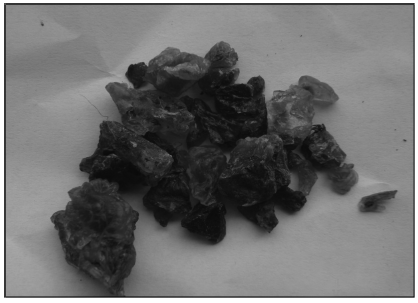
Figure 9.6 Guggulu
According to Ayurveda, based on the colour, guggulu is “hemaguggulu”—when of golden yellow colour, “mahisaksam”—dark brown colour, “padmaragabham”—ruby red colour, “bringabham”—deep blue colour and “kumudyudi”—off white colour. Guggulu is to be taken as a drug when freshly collected and its quality deteriorates on storage.
Constituents
It contains up to 8% aromatic essential oil, 30–60% gum and 20–40% resin. The oil constitutes octa nor dammarane terpenes, myrcene, dimyrcene, cuminic aldehyde, eugenol, manusambionic acid, and manusambinone. The sequiterpene fraction of the essential is responsible for the fragrant odor of guggulu. The gummy portion is a highly branched polysaccharide made up of D-galactose, L-arabinose, and 4-methyl ether of D-glucuronic acid. The resin portion contains diaryl furano furanoid lignans-sesamin and related products, a macrocyclic diterpenes such as cembrane A, esters of ferulic acid and of long chain polyhydroxylated saturated hydrocarbons called guggulutetrols—(Z)-5-tricosene-1,2,3,4-tetraol and (Z)-5-tetracosene-1,2,3,4-tetraol, Myrrhanol A and myrrhanone A.
The principal active constituents are considered to be guggulusterones Z and E. These pharmacologically important compounds occur along with guggulu sterols (I-VI), which are di or tri hydroxylated pregnane or cholestane type sterols.
While crude gum guggulu has 2% guggulusterones, its ethyl acetate extract is enriched having 4–5% guggulusterones.
Leave a Reply