It is a medium-sized handsome, evergreen tree up to 9 m height with numerous spreading and drooping glabrous branches. Leaves are paripinnate, 30–60 cm long having 2–3 pairs of lanceolate leaflets, which are oblong, lanceolate, and parallel veined. Flowers are orange yellow in dense corymbs and with great fragrance. Fruits are leathery, flat black pods, compressed seeds —ellipsoid, oblong, compressed. The bark is dark brown with a warty surface and the freshly cut ends are pale yellowish red turning red on exposure to air. Bark is channeled, smooth with circular lenticles and transversely ridged and sometimes cracked.
Chemical constituents
Bark is rich in tannins, constituted of (-) epicatechin, procyanidin, β -2,11’-deoxyprocyanidin B, (+) catechin, (24E)-24- methyl-cholesta-5-en-3-β-ol (22 E, 21Z)-24-ethycholesta-5,22 dien-33-ol,(24 E)-24- ethylcholesta-5-en-3-β-ol, leucopelargonidin-3-O- β –D glucoside, leucopelargonidin, and leucocyanidin. Five lignan glycosides, lyoniside, nudiposide, 5-methoxy-9-β-xylopyranosyl-(−)isolariciresinol, icariside E3, and schizandriside, and three flavonoids, (−)-epicatechin, epiafzelechin-(4β→8)-epicatechin, and procyanidin B2, together with β-sitosterol have been isolated form the bark.
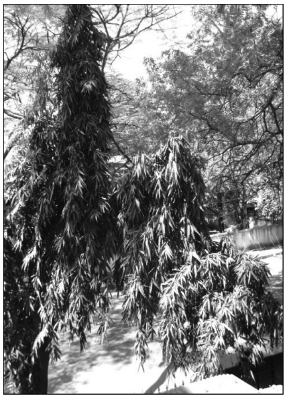
Figure 9.8 Saraca asoca
The flowers are constituted of mixtures of anthocyanins and other flavonoids including quercetin, kaempferol-3-0-β-D-glucoside, quercetin-3-0-β-D-glucoside, apigenin-7-0-β-D-glucoside, pelargonidin-3, 5- diglucoside, cyanidin-3, 5-diglucoside, palmitic, stearic, linolenic, linoleic, β and γ sitosterols, leucocyanidin, and gallic acid. Seed and pod contains oleic, linoleic, palmitic, and stearic acids.
Traditional uses
Bark, leaves, flowers, and seeds are used in traditional medicine. Bark is bitter, astringent, refrigerant, anthelmintic, styptic, stomachic, febrifuge, and demulcent. It is used as a uterine sedative and tonic, in dyspepsia, colic, ulcers, menorrhagia, leucorroea, and in the cure of pimples. In general, it is given in the treatment of all disorders related to the menstrual cycle.
Leaves are used in the management of gastric distress; flowers are used as a uterine tonic, in hemorrhagic dysentery, syphilis, hemorrhoids, and in diabetes. Seeds are used in treating bone fractures, strangury, and vesical calculi.
Ashoka and its plant parts are used in various traditional and folkloric recipes for vitiated conditions of pitta. Leaf juice mixed with cumin seeds is given for relief from gastric distress. The bark powder is consumed with boiled milk as a uterine tonic and to stop abnormal uterine bleeding and in general it is given in the treatment of all disorders related to the menstrual cycle.
Leave a Reply