CATABOLISM
Catabolism is defined as the degradative process concerned with the breakdown of complex molecules to simpler ones, with a release of energy. The very purpose of catabolism is to trap the energy of the biomolecules in the form of ATP and generate the substances (precursors) required for the synthesis of complex molecules. Catabolism occurs in three stages as shown in Figure 8.2.
Stage I – Conversion of complex into their building blocks
Polysaccharides are broken down to monosaccharide, lipids to free fatty acids and glycerol, and proteins to amino acids.
Stage II – Formation of simple intermediates
The building blocks produced in stage I are degraded to simple intermediates such as pyruvate and acetyl-CoA. These intermediates are not readily identifiable as carbohydrates, lipids, or proteins. A small quantity of energy (as ATP) is captured in stage II.
Stage III – final oxidation of acetyl-CoA
Acetyl-CoA is completely oxidised to CO2, liberating NADH and FADH2 that finally get oxidised to release large quantity of energy (as ATP). Krebs’s cycle of citric acid cycle is the common metabolic pathway involved in the final oxidation of all energy-rich molecules. This pathway accepts the carbon compounds (pyruvate, succinate, and so on) derived from carbohydrates, lipids, or proteins.
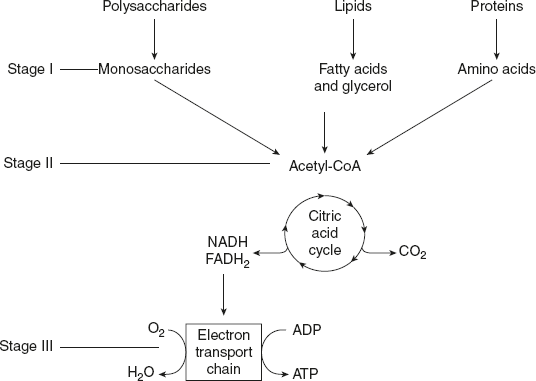
Figure 8.2 Outline Pathways for the Catabolism of Dietary Carbohydrates, Protein and Fat
Leave a Reply