The plant has been used in Chinese traditional medicine, where for centuries it has been used in the treatment of malaria, fevers, skin diseases, jaundice, and haemorrhoids in combination with other herbs.
As an herbal tea and infusion, the herb is an affordable and effective anti-malarial in the tropics and countries such as China and Vietnam where it is commercially available. Leaves are used as an anti-periodic, anti-septic, digestive, and febrifuge. Leaf infusion is used internally to treat fevers, colds, and diarrhea. Externally the leaves are given in the form of a poultice for headache, nosebleeds, boils, and abscesses. Seeds are used in the treatment of flatulence, indigestion, and night sweats. Essential oil obtained on steam distillation of the fresh aerial parts is widely used in the pharmaceutical, cosmetic, and flavoring industries.
Pharmacology
Artimisinin isolated from the leafy tops is selectively toxic to the asexual erythrocyte stage of various species of the malarial parasite like Plasmodium falciparum, P.vivax both in vivo and in vitro. It is effective against chloroquine-resistant strains of the parasite even at nanomolar concentrations. Several clinical trials have shown it to be 90% effective and more successful than standard drugs. It has been used in China for the treatment of malaria, especially cerebral malaria. Artemesinin and its semi-synthetic derivatives act as blood schizonticides. Artemether (methyl ether), arteether (β-ethyl ether) and artesunate (12 α-succinate), are the semisynthetic derivatives widely used as anti-malarials in the form of tablets, intramuscular, intravenous, and rectal applications.
Sodium artesunate and sodium artelinate are more water soluble and can be given orally or by injection. Artemisinin is given in combination with other anti-malarials like lumefantrine, amodiaquine, and mefloquine. It is also found to be effective against several species of rodent malarial parasite.
The sequiterpene enriched extract of Artemisia aerial parts is reported with anti-ulcerogenic activity and the essential oil is apoptotic to hepatocarcinoma cells (SMMC- 7721) in vitro. Anti fungal, insecticidal, and anti-convulsant activity of the essential oil is also reported. Artemisinin and flavonoid quercetagetin have shown inhibitory activity in several human tumor cell lines.
Artemisinin is reported to be a selective phytotoxin and it is also reported with anti-viral activity. Artemisinin, dihydroartemisinin, and arteether have demonstrated suppressed humoral immune response in experimental animals.
Artesunate is found to be inhibitory to chronic myeloid leukemia cells and breast cancer cells in vitro. It is also found to be anti-angiogenic.
Marketed products
Herb Pharm
Chirata
Refers to Swertia chirayita (Roxb ex.Fleming) Karsten, Family: Gentianaceae
Synonym
Swertia chirata (Wall) CB Clarke.
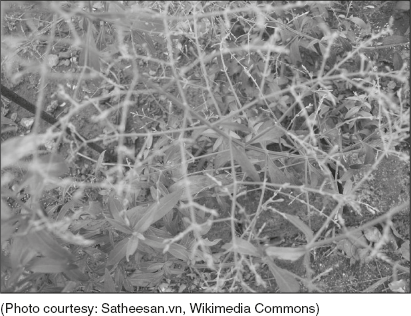
Figure 9.13 Swertia chirayita
The plant is found in temperate Himalayas at 1200–1300 m altitude from Kashmir to Bhutan and Khasi hills in Meghalaya. The whole plant was held in high esteem and has been used as medicine for centuries in ancient India.
Common vernacular names
English: Brown or white chiretta
Sanskrit: Kairata, Kirata-tikta, nepalinimbah
Hindi: Chirayata, nepalinum
Tamil: Cirattakuchi
Telugu: Nela vemu
Leave a Reply